
50 Cao Duc Lan Street, Binh Trung Ward, Ho Chi Minh City, Vietnam

+84 76 865 6688

info@beetech.com.vn
+84 76 865 6688

About us
Contact us



HOME
PRODUCTS
SOLUTIONS
INDUSTRIES
PROJECTS
NEWS


50 Cao Duc Lan Street, Binh Trung Ward, Ho Chi Minh City, Vietnam
+84 76 865 6688
info@beetech.com.vn
+84 76 865 6688
About us
Contact us
HOME
PRODUCTS
SOLUTIONS
INDUSTRIES
PROJECTS
NEWS

Industrial RFID antenna integration: accurate data collection and efficient inventory control
Automated data management – an inevitable trend in the digital era
In the age of industry 4.0, accurate data and quick traceability are key factors driving business efficiency. However, many warehouse and production systems still rely on manual or semi-automated data entry, which can easily lead to errors, misplaced items, and delays in inventory checks.
That’s why RFID (Radio Frequency Identification) technology was developed and it has quickly become the foundation of intelligent management systems. Within the RFID ecosystem, industrial RFID antenna plays a central role in collecting real-time data, improving accuracy, and automating the entire inventory control process.
A basic RFID system consists of three main components: RFID tags attached to items, RFID readers that process information, and RFID antenna the part responsible for transmitting and receiving radio signals between the two devices.
If the RFID tag is the data storage component, then the antenna acts as the “eyes and ears” of the system, ensuring signal transmission remains stable and precise. In industrial environments with metal, dust, heat, and strong interference, industrial RFID antenna are specially designed to handle heavy loads, maintain reliable operation, and read multiple tags simultaneously over long distances.
When an item with an RFID tag passes through the antenna’s coverage area, the radio signal emitted by the antenna activates the tag, prompting it to transmit its identification data (such as item code, location, or production batch).
The RFID reader then receives this information, converts it into digital data, and transfers it to a warehouse management system (WMS) or ERP platform. This entire process happens in milliseconds, allowing for real-time updates without manual scanning or data entry.
Thanks to their ability to read hundreds of RFID tags simultaneously, industrial antenna are especially suitable for:
Central warehouses and inbound–outbound zones
Automated packaging or production lines
Container gates, pallets, or conveyor systems
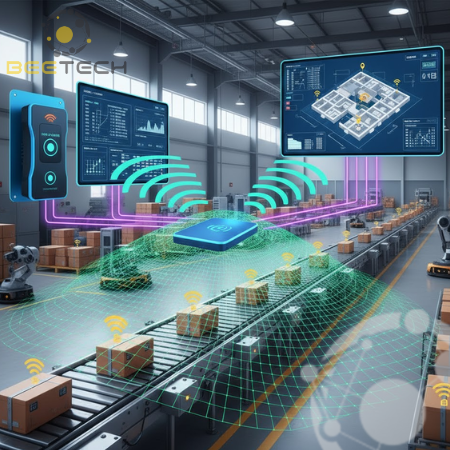
Previously, businesses faced numerous challenges in recording and processing warehouse data from human errors and inaccurate stock counts to lengthy inventory audits. Integrating RFID antenna into the management system fully automates this process.
Key benefits include:
Up to 99.9% data accuracy, thanks to non-line-of-sight reading.
Reduced human error no need for manual scanning or record-keeping.
Real-time data synchronization across warehouses, production lines, or branches.
Faster inventory checks reducing hours of work to just a few minutes.
For example, in an electronics factory, RFID antenna installed at pallet gates can record thousands of components every hour, ensuring the WMS always reflects accurate inventory levels, minimizing loss, and improving delivery performance.
RFID technology not only enables faster data capture but also ensures real-time, automated inventory control.
Operation process:
Each box or pallet is tagged with a unique RFID code.
When passing through an Antenna’s scanning zone, data is automatically recorded and updated in the management software.
The system identifies the location, status, and quantity of available goods.
As a result, businesses can:
Reduce inventory discrepancies and minimize losses.
Detect inconsistencies immediately when they occur.
Optimize safety stock levels and lower storage costs.
Plan smarter inbound–outbound logistics.
Depending on the operating environment and reading range, industrial RFID antenna can be classified into three main categories:
UHF (Ultra High Frequency) antenna:
Long-range reading (up to 12–15m) and high-speed performance.
Ideal for warehouses, logistics, and large-scale production lines.
HF (High Frequency) antenna:
Medium-range reading (up to 1m).
Suitable for pharmaceuticals, retail, and access control applications.
LF (Low Frequency) antenna:
Short-range reading, strong anti-interference capabilities in humid or metallic environments.
Commonly used in agriculture, transportation, and livestock management.
Most industrial antenna today support flexible connectivity, come with IP65–IP67 dust and water protection, and operate reliably under harsh industrial conditions.
To help businesses choose the right solution, here are some of the most widely used industrial RFID antenna:
Ultra-thin and lightweight design, easy to mount on walls, gates, or conveyor belts.
High performance with linear or circular polarization options.
Ideal for warehouses, retail stores, and distribution centers.
One of the world’s leading RFID technology brands.
Offers wide frequency range, stable performance, and excellent compatibility with Impinj R700 readers.
Renowned for durability and resistance to harsh industrial conditions.
Available in multiple models such as Zebra AN480, AN720, and AN440, offering different scanning angles and power levels.
Widely used in logistics warehouses, assembly plants, and distribution hubs.
To maximize efficiency, RFID Antenna must be seamlessly integrated with existing enterprise software such as ERP, WMS, or MES systems.
Integration process includes five steps:
Site survey – determine coverage area and optimal antenna placement.
Signal design – calculate transmission power and beam direction.
Hardware connection – link readers, antenna, and signal cables.
Software integration – synchronize data automatically with management platforms.
Calibration and testing – verify stability and eliminate interference zones.
When properly implemented, an RFID system operates seamlessly, enabling real-time tracking, discrepancy alerts, and optimized warehouse performance.
Integrating industrial RFID antenna is a strategic step for businesses transitioning from manual management to intelligent automation. As data becomes the foundation of modern operations, investing in RFID infrastructure means investing in transparency, efficiency, and long-term sustainability.
With over 12 years of experience in the AutoID industry, Beetech takes pride in being one of Vietnam’s leading providers of RFID solutions and smart devices.
Our team of experienced engineers accompanies your business through every stage from consultation and implementation to full lifecycle support ensuring your RFID systems operate seamlessly and deliver maximum value.
Let Beetech be your trusted partner on the journey to building intelligent management systems that enhance your competitiveness and drive success in the digital era.
📧 Email: info@beetech.com.vn
🌐 Website: https://beetech.com.vn



RFID – A new direction in bank document management.

28/01/2026 04:38:54

What Makes Beetech’s Asset Management Software Different from Other Solutions?
12/01/2026 03:45:27

What is RFID? Is RFID Implementation Expensive?
10/01/2026 07:38:29

RFID Tags Supplier – Ready to Supply All Types | Beetech
09/01/2026 06:54:14
National Traceability System Launch & RFID Traceability Solutions
06/01/2026 08:07:37

What Is RFID? The Contactless Identification Technology Transforming How Businesses Operate
05/01/2026 04:14:42