
80-82 Cao Duc Lan, District 2, HCMC, Vietnam

+84 76 865 6688

info@beetech.com.vn
+84 76 865 6688

About us
Contact us



HOME
PRODUCTS
SOLUTIONS
INDUSTRIES
PROJECTS
NEWS


80-82 Cao Duc Lan, District 2, HCMC, Vietnam
+84 76 865 6688
info@beetech.com.vn
+84 76 865 6688
About us
Contact us
HOME
PRODUCTS
SOLUTIONS
INDUSTRIES
PROJECTS
NEWS

Airport baggage tracking with RFID - An effective solution to prevent lost luggage
The fear of lost luggage is one of the most stressful experiences for any air traveler. The image of waiting hopelessly by an empty baggage carousel has become a classic nightmare. For decades, the aviation industry has relied on barcode technology to process billions of bags each year.
However, this method is revealing its inherent limitations and can no longer meet the demands for speed and accuracy in the digital age.
It is in this context that Radio-Frequency Identification, or RFID, has emerged as a revolution, promising to completely change how airport luggage tracking is done, bringing peace of mind to passengers and superior efficiency to airlines.
To understand the value of RFID, we must first recognize the weaknesses of the traditional barcode system. Barcodes are an optical identification method, requiring a scanner to “see” the code directly at a certain distance and angle. This “line-of-sight” requirement leads to a host of problems.
The read rate is low. Baggage tags can easily become wrinkled, torn, dirty, or obscured, preventing scanners from reading them. The success rate for barcode scanning in the aviation industry is often only between 80-90%, an unacceptable figure given the enormous volume of luggage. This leads to bags being mishandled or requiring manual intervention.
The process becomes time-consuming. When automated scanners fail, staff must use handheld scanners, sometimes having to physically turn bags over to find the tag, slowing down the entire system and increasing the risk of human error.
Barcodes lack real-time update capabilities. They are a static technology, providing data only at the point of scanning, not a continuous stream of information. These limitations not only inconvenience passengers but also cost airlines billions of dollars annually and damage brand reputation. The need for a new, accurate, and automated airport luggage tracking system has become urgent.
RFID (Radio-Frequency Identification) is the core technology for modern airport luggage tracking, using radio waves to automatically identify and track tags attached to objects. A basic RFID system includes three components: an RFID tag, an RFID reader, and software.
The key difference is that RFID does not require a line of sight. A reader can identify hundreds of RFID tags simultaneously from several meters away, even if the tags are obscured and the luggage is moving at high speed. This is a game-changer for airport luggage tracking.

Let’s follow the journey of a suitcase equipped with RFID technology:
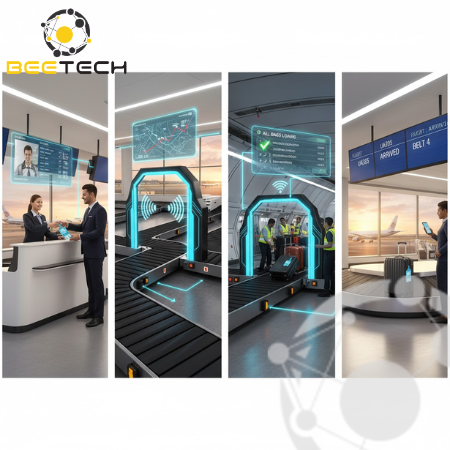
The transition to luggage tracking with RFID is a leap forward with comprehensive benefits.
Despite the undeniable benefits of luggage tracking with RFID, its global implementation still faces some challenges.
RFID luggage tracking technology is a critical foundation for building the “smart airports” of the future. When combined with Artificial Intelligence (AI), the Internet of Things (IoT), and big data analytics, the potential of RFID will expand even further. We can envision a future where luggage is handled intelligently, perhaps automatically delivered to your hotel. In Vietnam, the aviation industry is growing strongly, and adopting RFID at major international airports is an essential step to keep pace with global trends, enhance competitiveness, and provide the best passenger experience.
The RFID revolution in airport luggage tracking is well underway. By replacing outdated barcode technology with a smart, accurate, and transparent system, RFID luggage tracking technology is solving one of the airline industry’s most persistent problems.
For passengers, it marks the end of lost-luggage anxiety. For airlines and airports, it heralds a new era of operational efficiency and customer satisfaction. The journey of a suitcase is becoming smarter than ever.
With over 12 years of experience in the AutoID industry, Beetech takes pride in being one of Vietnam’s leading providers of RFID solutions and smart devices.
Our team of experienced engineers accompanies your business through every stage — from consultation and implementation to full lifecycle support — ensuring your RFID systems operate seamlessly and deliver maximum value.
Let Beetech be your trusted partner on the journey to building intelligent management systems that enhance your competitiveness and drive success in the digital era.
📧 Email: info@beetech.com.vn
🌐 Website: https://beetech.com.vn

See more products: Here


RFID in Logistics – The Core Technology Powering Modern Supply Chains

17/11/2025 06:21:25

RFID – The “Silent” Technology Transforming How Vietnamese Businesses Manage Their Inventory
13/11/2025 07:16:17

National Assembly Proposes Using Electronic Chips to Monitor Drug Addicts
12/11/2025 03:56:38
Vietnam’s RFID Logistics Market: Rapid Growth from 2025 to 2031
12/11/2025 03:13:47

RFID – When data becomes reality: The journey to building systems of reality in the digital ge
07/11/2025 02:57:55
Challenges in RFID Reading Performance and Environmental Conditions
06/11/2025 02:36:26